

Blog
Body Worn Camera: Complete Guide to Features, Uses & Buying in India

Body Worn Camera: Complete Guide to Features, Uses & Buying in India
A Body Worn Camera (BWC) is a compact wearable camera designed to record video and audio while being carried or worn by a person during field operations. Body worn cameras are widely used by police departments, traffic police, private security agencies, industrial security teams, logistics companies, government organizations, and emergency response teams to document incidents and create video evidence.
Modern body worn cameras can offer features such as HD or Ultra HD video recording, infrared night vision, GPS positioning, Wi-Fi/4G connectivity, secure storage, password protection, long battery life, and real-time monitoring or streaming, depending on the model.
For organizations in India looking for a professional body worn camera, the right choice depends on the operating environment, recording requirements, battery backup, storage capacity, connectivity, durability, and evidence-security requirements.
What Is a Body Worn Camera?
A Body Worn Camera is a small wearable video recording device that can be attached to a uniform, shirt, vest, or other suitable mounting point.
Unlike a fixed CCTV camera, a body worn camera moves with the person wearing it. This makes it useful when security personnel, police officers, inspectors, or field teams need to record events while moving between different locations.
A typical Body Worn Camera can capture:
- Video
- Audio
- Photos or snapshots
- Date and time information
- Location information through GPS on supported models
Some professional models also support wireless connectivity, allowing recorded information to be transferred or, where supported, video to be monitored remotely.
How Does a Body Worn Camera Work?
A body worn camera generally combines a camera sensor, microphone, battery, internal storage and control interface in a compact device.
The basic process is simple:
Wear → Record → Store → Transfer/Monitor → Review
The user can start recording using a dedicated button. Depending on the model, the camera may record video and audio simultaneously and store the footage in internal memory.
Advanced body worn camera systems may also provide GPS, Wi-Fi, 4G/LTE connectivity, remote monitoring, live streaming and communication features.
For example, the GV Tel SBWC-01 Sanchar Body Worn Camera supports video and audio recording, GPS positioning, 4G/Wi-Fi connectivity, optional live streaming, remote monitoring and up to 256 GB of internal storage.
Why Are Body Worn Cameras Used?
Body worn cameras provide a mobile perspective that fixed surveillance systems cannot always capture.
They can help organizations:
- Document incidents
Recorded video can provide a visual record of an interaction, inspection, security incident or field operation.
- Support evidence collection
Video and audio recordings can help document events and observations. Public-sector guidance identifies evidence collection and documentation as important applications of body-worn camera systems.
- Improve situational awareness
Some connected body cameras can transmit information to a remote command centre or authorized monitoring system, depending on the model and network configuration.
- Support security operations
Security guards and field personnel can use wearable cameras while patrolling campuses, warehouses, industrial facilities, transportation areas and other locations.
- Create a mobile surveillance layer
A CCTV camera remains in a fixed position. A body worn camera accompanies the user, providing a different perspective during mobile operations.
Where Are Body Worn Cameras Used?
Body worn cameras have applications across multiple sectors.
Police and Law Enforcement
Police officers can use body cameras to record interactions, field activities and incidents. Professional BWC systems may include GPS, night vision, secure recording and communication features.
Traffic Police
Traffic enforcement teams can use body cameras to document roadside activities and interactions.
Private Security
Security guards can wear body cameras while patrolling commercial buildings, residential complexes, campuses, warehouses and industrial sites.
Industrial Security
Industrial facilities often have personnel moving across large areas. A wearable camera can provide mobile incident documentation.
Logistics and Warehousing
Security and operations teams can use body cameras during inspections, movement of goods and incident response.
Railway and Airport Security
Mobile security personnel can use body worn cameras when fixed CCTV coverage is insufficient for documenting activity from the officer’s perspective.
Government Organizations
Government departments and field teams can use body cameras for inspections, enforcement and other mobile operations, subject to applicable policies and legal requirements.
Emergency Response Teams
Connected body cameras can provide operational visibility during certain field-response scenarios.
GV Tel currently lists these applications on its Body Worn Camera category page, including police departments, traffic police, private security, industrial security, warehouses, logistics companies, railway security, airport security, government organizations and emergency response teams.
Key Features to Look for in a Body Worn Camera
Choosing a body worn camera should go beyond simply looking at megapixels. The operating environment and evidence requirements are equally important.
- Video Resolution
Higher resolution can provide more visual detail, but it also increases storage requirements.
Professional body cameras can offer HD or Ultra HD recording. The exact resolution should be selected according to the intended use and storage capacity.
- Infrared Night Vision
For security operations that continue after dark, infrared night vision can help capture usable footage in low-light environments.
The SBWC-01 listed by GV Tel includes IR night vision and Ultra HD video recording.
- Battery Backup
Battery life is particularly important for personnel working long shifts.
Before purchasing a body worn camera, consider whether the battery can support the expected operational period and whether charging arrangements are available between shifts.
- Internal Storage
Storage determines how much footage can be retained before files need to be transferred.
The GV Tel SBWC-01 supports up to 256 GB internal storage, while the SBWC-01+ also lists up to 256 GB storage.
- GPS
GPS can add location information to supported recordings and help organizations understand where an event occurred.
For field operations, location data can be particularly useful when reviewing incidents.
- Wi-Fi and 4G Connectivity
Connectivity can enable data transfer and, on supported models, remote monitoring or live streaming.
The SBWC-01 supports 4G and Wi-Fi connectivity and offers optional live streaming.
- Secure Data Protection
A body camera may contain sensitive operational footage. Password protection, access control and tamper-resistant recording features should therefore be considered.
The SBWC-01 listed by GV Tel includes password protection and states that unauthorized personnel cannot tamper with or delete recorded files.
- Water and Dust Resistance
Security personnel may operate outdoors in difficult weather conditions. An appropriate IP rating can help protect the device against environmental exposure.
For example, GV Tel lists up to IP68 for its SBWC-01 and up to IP67 for the SBWC-01+.
- Audio Recording
For many applications, audio is as important as video.
A professional body worn camera should therefore be evaluated for simultaneous audio and video recording and the quality of captured sound.
- Ease of Operation
During an incident, users should be able to start recording quickly.
Features such as one-click recording, one-click photography and simple controls can make the camera more practical for field personnel.
Body Worn Camera vs CCTV Camera
A body worn camera and CCTV camera serve different purposes.
| Feature | Body Worn Camera | CCTV Camera |
| Position | Worn by a person | Fixed installation |
| Coverage | Moves with the user | Covers a defined area |
| Mobility | High | Low |
| Typical use | Field operations and mobile security | Premises surveillance |
| Perspective | Wearer’s viewpoint | Fixed viewpoint |
| GPS | Available on selected models | Usually not a core feature |
| Live monitoring | Available on selected models | Common in networked systems |
| Best suited for | Police, guards, inspectors, field teams | Buildings, entrances, corridors, sites |
In many security environments, body worn cameras and CCTV can complement each other rather than replace one another.
Body Worn Camera vs Dash Camera
A dash camera is generally mounted on a vehicle, while a body worn camera is attached to a person.
A dash camera primarily records from the vehicle’s position. A body worn camera moves with the officer or security professional.
For mobile field operations, the body worn camera can therefore capture interactions and activities outside the vehicle.
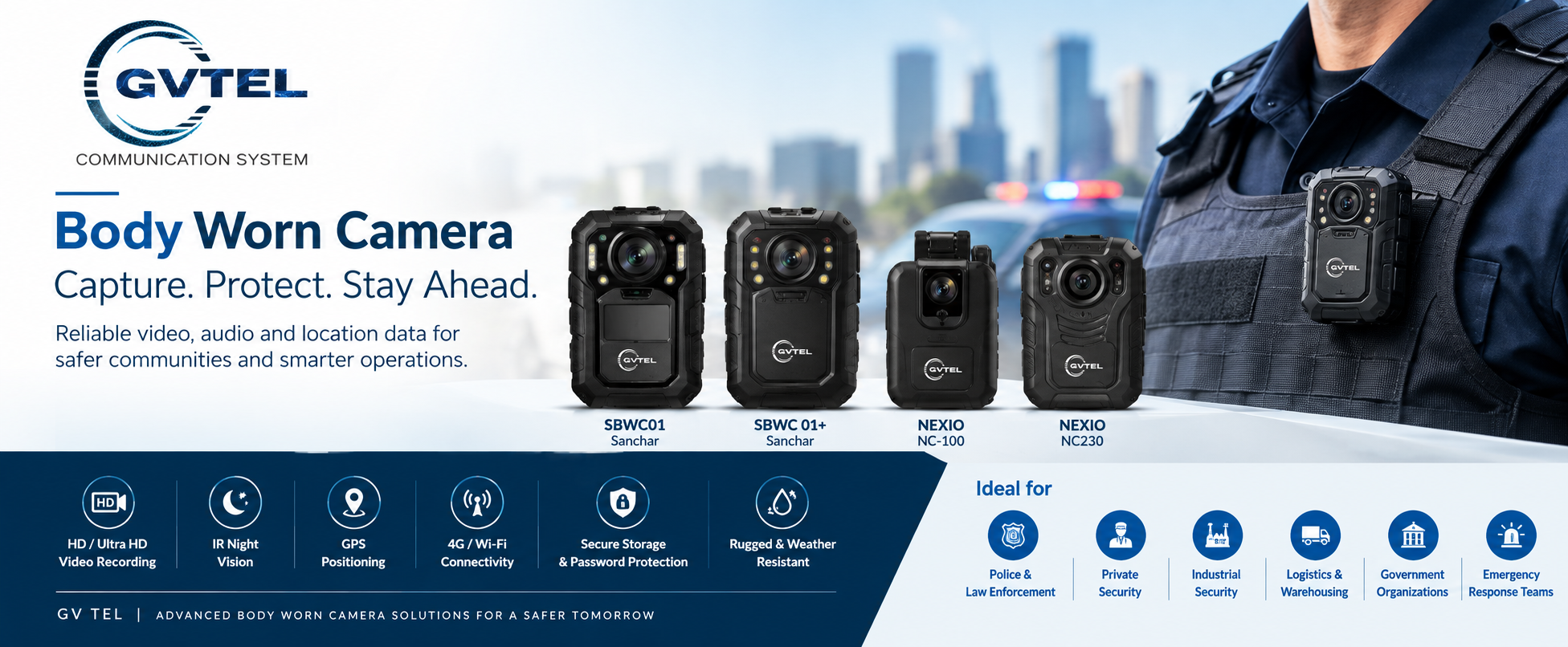
Body Worn Camera Models Available from GV Tel
GV Tel’s current Body Worn Camera lists products.
- BODY WORN CAMERA – SBWC01 Sanchar
The SBWC-01 is designed for professional body-worn recording and includes:
- Ultra HD video
- IR night vision
- GPS positioning
- LCD colour display
- Up to 40 MP
- Password protection
- Remote real-time talk
- One-key alarm
- 3500 mAh Li-ion battery
- 4G and Wi-Fi connectivity
- Optional live streaming
- Up to 256 GB internal storage
- Simultaneous video and audio recording
- Remote monitoring and location features
- Up to IP68 protection
GV Tel also states that the model has IMEI and MAC address in the OEM name and lists NABL, BIS, CE, RoHS and FCC certifications.
- BODY WORN CAMERA – SBWC 01+ Sanchar
The SBWC-01+ includes:
- Up to IP67
- Up to 256 GB storage
- IR night vision
- Ultra HD video
- GPS/Wi-Fi optional
- LCD colour display
- Up to 40 MP
- Password protection
- 3500 mAh Li-Polymer battery
- One-click photo/recording
- Snapshot while recording
- Simultaneous video and audio recording
The manufacturer describes applications including law enforcement, commercial, healthcare, military, journalism and other surveillance uses.
- NEXIO NC-100
GV Tel’s category page currently lists the NEXIO NC-100 as a Body Worn Camera product.
- NEXIO NC230
The NEXIO NC230 is also listed in GV Tel’s current Body Worn Camera category.
For organizations comparing models, the most suitable specification depends on the intended application, required storage, connectivity, battery requirements and operating environment.
How to Choose the Right Body Worn Camera in India
Before purchasing a Body Worn Camera, create a requirement checklist.
For police and law enforcement
Consider:
- Video and audio quality
- Night vision
- GPS
- Battery backup
- Secure evidence storage
- Tamper resistance
- 4G/Wi-Fi connectivity
- Remote monitoring
- Data management requirements
For private security
Focus on:
- Easy one-button recording
- Battery life
- Rugged construction
- Night vision
- Storage capacity
- Water/dust resistance
- Ease of deployment
For industrial and logistics operations
Consider:
- Durability
- Long operating time
- Storage
- GPS
- Connectivity
- Ease of charging
- Environmental protection
Official body-camera technology guidance also recommends considering factors such as recording format, video resolution, low-light performance, metadata, tamper resistance, data transfer, storage, battery life and durability when evaluating BWC systems.
How Much Does a Body Worn Camera Cost in India?
The price of a Body Worn Camera in India varies depending on its specifications, storage capacity, connectivity, durability, battery capacity and evidence-management capabilities.
For reference, GV Tel’s current product lists:
- SBWC01 Sanchar: ₹26,500 before the listed 18% GST
- SBWC 01+ Sanchar: ₹19,200 before the listed 18% GST
- NEXIO NC-100: ₹9,000 before the listed 18% GST
- NEXIO NC230: ₹25,000 before the listed 18% GST
Instead of choosing a camera only by price, organizations should compare the features required for their actual deployment.
Is a Body Worn Camera Useful for Security Guards?
Yes. A body worn camera can be useful for security guards because it provides a mobile recording perspective during patrols, access-control incidents, disputes, inspections and emergency situations.
The usefulness depends on how the organization deploys the cameras, its recording policy, data-storage process, privacy requirements and the type of security work being performed.
What Should Organizations Consider Before Deployment?
Buying the hardware is only one part of implementing a body worn camera system.
Organizations should also establish:
- Who is authorized to use the camera
- When recording should start and stop
- How footage will be stored
- Who can access recordings
- How long recordings should be retained
- How footage will be transferred
- How incidents will be documented
- How privacy and applicable laws will be handled
- How devices will be charged and maintained
For law-enforcement deployments, official guidance emphasizes that technology selection should be aligned with operational needs and applicable jurisdictional requirements.
Why Buy a Body Worn Camera from an Indian Supplier?
For organizations deploying body cameras at scale, working with a local supplier can simplify product consultation, procurement, technical support, delivery and after-sales communication.
GV Tel is a Delhi-based supplier of communication and security products and currently offers Body Worn Camera systems for organizations across India, including bulk procurement and government/enterprise requirements.
What is a Body Worn Camera?
A Body Worn Camera is a wearable device that records video and audio while a person performs field, security, law-enforcement or inspection duties.
What is the use of a Body Worn Camera?
Body worn cameras are used to document incidents, record interactions, collect video evidence, improve operational visibility and support mobile security activities.
Who uses Body Worn Cameras?
Police departments, traffic police, private security agencies, industrial security teams, logistics companies, government organizations and emergency response teams can use body worn cameras.
Do Body Worn Cameras record audio?
Yes. Many professional body worn cameras support simultaneous audio and video recording. GV Tel’s SBWC-01 and SBWC-01+ both list simultaneous video and audio recording.
Do Body Worn Cameras have night vision?
Selected models provide infrared night vision. For example, both GV Tel’s SBWC-01 and SBWC-01+ list IR night vision.
Do Body Worn Cameras have GPS?
Some models include GPS positioning. The GV Tel SBWC-01 lists GPS positioning and remote location functionality.
Can a Body Worn Camera stream live video?
Some connected body cameras support live streaming through cellular or Wi-Fi networks. The GV Tel SBWC-01 lists optional live streaming and 4G/Wi-Fi connectivity.
How much storage does a Body Worn Camera need?
Storage requirements depend on video resolution, compression, recording duration and operational use. Higher-resolution video generally requires more storage. Some professional models support large internal storage; GV Tel’s SBWC-01 and SBWC-01+ list up to 256 GB.
What is the price of a Body Worn Camera in India?
Body worn camera prices vary by model and specifications. GV Tel’s current product category lists models from ₹9,000 to ₹26,500 before the displayed 18% GST, with pricing subject to change.
Where can I buy a Body Worn Camera in India?
Organizations can purchase Body Worn Camera systems from specialized security and surveillance suppliers. GV Tel currently supplies Body Worn Camera products in India and lists support for bulk, government and enterprise requirements.